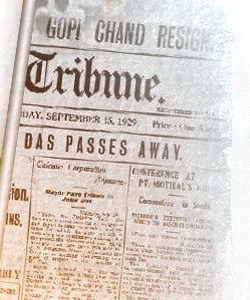
News of the death travelled quickly. Two days later, on 15 September 1929, The Tribune of Lahore carried it on its front page, printing a photograph with the caption “He died fighting for better treatment of political prisoners”. The historian Kama Maclean has noted that the impact of that front page on nationalist politics was such that the British subsequently stopped handing over the bodies of revolutionaries to their families.
In the Central Legislative Assembly, Motilal Nehru moved for an adjournment as a censure of the treatment of the Lahore prisoners; the motion was carried against the government by 55 votes to 47. In the Punjab Legislative Council, Mohammad Alam and Gopi Chand Bhargava resigned in protest. Within months the government appointed a jail enquiry committee in the Punjab, and the remaining strikers suspended their protest on assurances from its members that the question of the treatment of political prisoners would shortly be settled — an assurance repeated publicly in the Assembly by Sir James Crerar. The strike as a whole is generally described as having lasted 116 days.
Das's body was released to his family and carried by train from Lahore towards Calcutta. What happened along that route, and what happened when it arrived, belongs to the next chapter.