Chapter 05 · 13 July – 13 September 1929
Resistance
without escape
A hunger strike is a strange kind of protest. It has no target but the person making it, and no force behind it except the willingness of the state to be seen letting someone die. In Lahore in 1929 that willingness was tested for sixty-three days.
Strike begins — 15 June 1929
Das joins — 13 July 1929
Das dies — 13 September 1929
June–July 1929
A dispute the courts would not hear
The men held in Lahore in the summer of 1929 had two separate problems. The first was the prosecution itself, which their lawyers could contest. The second was the conditions of their imprisonment, which no court would entertain, because the treatment of prisoners was an administrative matter within the discretion of the jail authorities.
Their grievance was specific: Indian political prisoners were held on the same terms as ordinary criminal convicts, and on substantially worse terms than European prisoners. The food was inadequate and often unsafe. The prison clothing was not changed or washed for long periods. Political prisoners were dispersed among the general population, subjected to the labour assigned to convicts, and denied books, writing materials and newspapers — a serious deprivation for a group composed largely of students.
Having no legal remedy, they used the only pressure available to people with nothing: their own bodies. On 15 June 1929 Bhagat Singh and Batukeshwar Dutt began a hunger strike. Over the following weeks others held in connection with the case joined it. Jatindra Nath Das joined on 13 July 1929.
He had done this before. Four years earlier, at Mymensingh, a fast of about three weeks had produced an apology from the Jail Superintendent and an end to the protest. There was every reason in his own experience to expect that this one, too, would end in a negotiated concession.
Summer 1929
Status, not release
It is worth repeating, because it is the point most often lost: none of the strikers was asking to be let out. Das in particular was offered release on bail as his condition deteriorated, and refused it. What they were asking for was a change in how the state classified and therefore treated them.
Their demands, as set out in the prisoners' own restatement of January 1930, concerned the ordinary conditions of confinement: exemption from hard and undignified labour, housing together in one ward rather than dispersal, at least one daily newspaper, proper facilities for study, and permission to supplement prison food and clothing at their own expense. Underlying all of them was a single argument about classification — that political prisoners constituted a distinct category, and that motive should be, in their words, “the most important factor in the criteria for classification”.
Put plainly: they were arguing that a government cannot claim to rule by law and simultaneously treat its political opponents as though the law does not reach them. It is an argument about the limits of state power over people it has already deprived of everything else, and it did not stop being relevant in 1929.
… the most important factor in the criteria for classification.
On the place of motive — statement of the Lahore Conspiracy Case under-trials, 28 January 1930July–August 1929
Force-feeding, and its consequences
The colonial administration's answer to the strike was to feed the prisoners by force. This was not unusual: force-feeding had been used against hunger strikers in Britain and Ireland for two decades, and it was understood at the time to be both painful and dangerous.
In Das's case the consequences were serious. Accounts of his imprisonment record that the attempts to feed him forcibly injured his lungs, and that his health deteriorated sharply afterwards. Out of respect for him and for the young readers this archive is written for, no clinical description of that deterioration is given here. It is enough to say that a healthy twenty-four-year-old was, by the beginning of September, gravely ill as a direct result of both the fast and the manner in which the authorities responded to it.
The pressure this generated was political rather than medical. Newspapers — The Tribune of Lahore prominently among them — reported the strikers' condition regularly. Members of the Punjab Legislative Council and the Central Legislative Assembly raised the matter. What had begun as a dispute inside a prison became, over the course of a summer, a national argument about the legitimacy of the government conducting it.
September 1929
The offer, and the refusal
By early September Das's condition was serious enough that the jail authorities are recorded as having recommended his unconditional release. The government declined that recommendation and offered instead to release him on bail.
The distinction mattered entirely. Unconditional release would have been an acknowledgement that he had been wrongly held in the conditions he was protesting. Bail was a routine criminal-procedure device that conceded nothing at all, and accepting it would have abandoned the position the strike existed to assert. The offer was refused.
A medical note dated 12 September 1929 recorded a temperature of 100°F in the morning and 99°F in the evening, and a pulse of 130 — described in the note as very rapid.
He died the following day.
13 September 1929
The sixty-third day
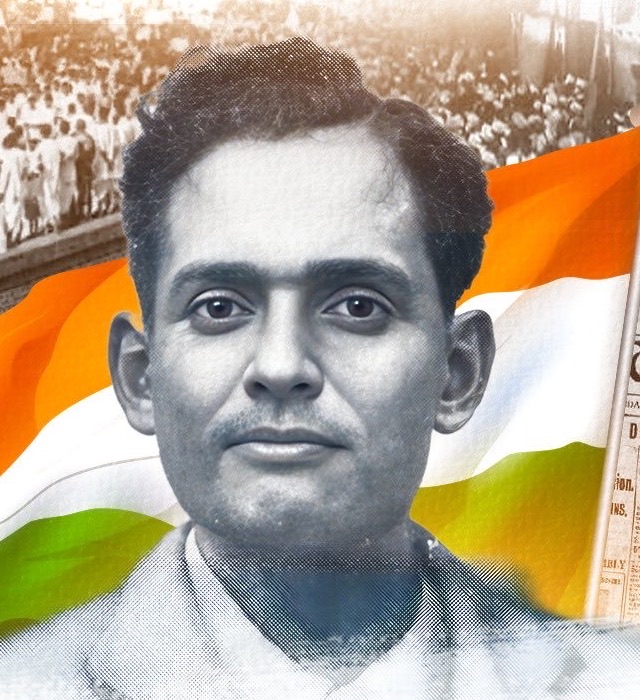
Jatindra Nath Das died in prison in Lahore on Friday 13 September 1929, in the presence of his younger brother Kiron. Sources place the death at the Borstal Jail, Lahore, and give the time as one o'clock in the afternoon. He was twenty-four years old, and would have turned twenty-five the following month.
The strike he had joined did not end with him. It continued afterwards, and is generally described as having run 116 days in all before being suspended on assurances from the members of the Punjab Jail Enquiry Committee that the question of the treatment of political prisoners would shortly be settled.
What his death did was to move the argument out of the prison entirely. Two days later, The Tribune of Lahore carried the news on its front page. His body was carried by rail towards Calcutta, and people gathered at stations along the route. In the Central Legislative Assembly, Motilal Nehru's censure motion over the treatment of the Lahore prisoners was carried against the government by 55 votes to 47. In the Punjab Legislative Council, Mohammad Alam and Gopi Chand Bhargava resigned.
A man who had never been convicted of anything, and whose demand was that prisoners be given clean clothes, decent food and something to read, had made the government's prison policy into a matter the government could not win.
How this chapter is written
This page describes a hunger strike as a documented political act in its historical setting. It deliberately contains no clinical account of starvation, no images of Das in illness, and nothing that could be read as instruction or encouragement. Fasting to the point of harm is not presented here as admirable in itself; what is described is a political argument about the treatment of prisoners, and the extreme circumstances in which men with no other recourse chose to make it.
If you or someone you know is struggling with food, eating or self-harm, please speak to a doctor or a trusted adult.
Sources for this page
- 01“Jatindra Nath Das”, Wikipedia — the start date of 13 July 1929, the 63-day duration, force-feeding and its effect on his lungs, the recommendation of unconditional release and the bail offer, the medical note of 12 September 1929, and the death on 13 September 1929 at the Borstal Jail. en.wikipedia.org
- 02“Hunger-Strikers' Demands Reiterated”, 28 January 1930 — the prisoners' own statement of their demands and of the place of motive in classification. marxists.org
- 03“The Tribune photo on Jatin Das shook British empire”, The Tribune (Chandigarh) — the paper's front-page coverage of 15 September 1929 and its regular reporting of the strikers' condition. tribuneindia.com
- 04“Batukeshwar Dutt”, Wikipedia — the hunger strike begun on 15 June 1929 and its overall duration of 116 days. en.wikipedia.org