Enquiries +91 97699 99960 im@digantsharma.com
Plate 04 Portrait study
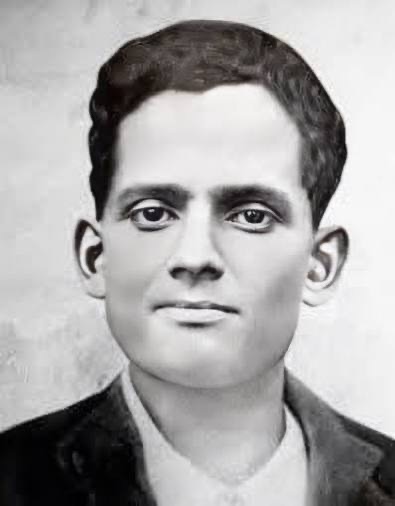
A retouched close portrait of Jatindra Nath Das, facing forward, wearing a dark jacket over a light collarless shirt.
Portrait study of Jatindra Nath Das. A later, retouched reproduction of a photograph of Das. The original photograph is undated.

Chapter 03 · 1925–1929

The making
of a revolutionary

Two organisations, four prisons and roughly seven months of freedom. This chapter sets out what is documented about Jatin Das's political life — and marks clearly where the documentation stops.

01 Definitions

What “revolutionary” meant
in colonial India

By the 1920s the Indian movement against British rule contained several distinct strands, and they disagreed with each other as much as they agreed.

The constitutional strand worked through the Indian National Congress and, after 1919, through the partly elected legislatures the colonial government had created. Its instrument was pressure: resolutions, elections, negotiation, and the slow expansion of Indian participation in government.

The mass non-violent strand, associated above all with Gandhi, rejected both violence and quiet negotiation in favour of disciplined, public, deliberately illegal non-cooperation — boycott, picketing, refusal of taxes, and voluntary imprisonment in very large numbers.

The revolutionary strand — the one Das belonged to — held that a colonial state which governed by force would not be argued out of power, and organised in secret. Its members were mostly young, mostly students or recent students, and drawn disproportionately from Bengal, Punjab and the United Provinces. Colonial law classified them as terrorists; they described themselves as revolutionaries fighting a war of national liberation.

The differences were not only about tactics. By the late 1920s the younger revolutionaries had become explicitly socialist. When the Hindustan Republican Association was reorganised in 1928 it added the word to its name, becoming the Hindustan Socialist Republican Association, and its programme extended past independence to the reorganisation of Indian society itself.

It is important to be precise about what these organisations did and did not do, because a great deal of loose writing surrounds them. They were small. They were repeatedly broken up by arrests, informers and conspiracy trials. They had no mass following, and their leaders knew it: much of what they did was intended to be heard rather than to be militarily effective — acts designed, in Bhagat Singh's phrase at his trial, to make the deaf hear.

This archive describes these organisations historically. It does not describe how any of their activities were carried out, and no operational detail of any kind appears on this site. The subject here is a political conflict and a young man's part in it, not a set of methods.
02 Affiliations

The two organisations
he is recorded as joining

Org 01

Anushilan Samiti

Founded c. 1902 · Bengal

The largest and oldest of Bengal's revolutionary societies, begun as a network of physical-culture and self-discipline clubs in Calcutta and Dacca and developing into a clandestine political organisation with a very large student membership. It was a principal target of colonial security policy for three decades, and its members were subject to mass detention without trial. Das is recorded as a member by the time of his arrest in November 1925.

Org 02

Hindustan Socialist Republican Association

Reorganised 1928 · All-India

Formed out of the Hindustan Republican Association, which Sachindra Nath Sanyal had helped found earlier in the decade. Its best-known members were Bhagat Singh, Sukhdev Thapar, Shivaram Rajguru, Chandrashekhar Azad and Batukeshwar Dutt. Das is recorded as becoming associated with the HSRA after his release from prison at the end of October 1928, and as having learned the technical side of the work from Sanyal.

What is not documented

When Das joined the Anushilan Samiti, who recruited him, what position he held in either organisation, and what he personally believed about their aims are all unrecorded in the sources consulted here. No letters, diaries or political statements by him have been located. Every account of his inner life that circulates online is, so far as this archive can establish, a reconstruction.

03 1925–1928

Four prisons before Lahore

The single most important fact about Jatin Das's hunger strike is that he had been inside colonial prisons before, and had already used the same weapon once.

1921 · Hooghly Jail

The first sentence

Convicted for picketing shops selling foreign cloth during the Non-Cooperation Movement, at seventeen. A short, ordinary sentence of the kind thousands of Indians served in 1921 — and his introduction to the inside of the system he would later fast against.

November 1925 · Mymensingh Central Jail

Detention, and a fast that worked

Arrested while reading for his B.A. and imprisoned at Mymensingh, in what is now Bangladesh. There he went on hunger strike in protest at the treatment of political prisoners. Accounts differ slightly on the length — twenty days in some, twenty-one in others — but agree on the outcome: the Jail Superintendent apologised, and Das ended the fast.

This episode is the direct rehearsal for 1929. It established, four years early, both the grievance and the method.

1926–1928 · Dacca Central Jail, then Mianwali Jail

Transferred, and transferred again

He was moved from Mymensingh to Dacca Central Jail, and afterwards to Mianwali Jail in the Punjab — a transfer recorded as a punitive consequence of the Mymensingh protest. Moving a detainee a thousand miles from his family and his political network was a standard instrument of colonial prison administration.

End of October 1928

Released

He was freed after roughly three years of detention, at twenty-four. It is in the months that follow that he becomes associated with the HSRA. He would be at liberty for approximately seven months.

04 Association

Jatin Das and Bhagat Singh

The two names are permanently linked in Indian memory, and the link is real — but it is more specific and more limited than popular retellings suggest, so it is worth stating carefully.

What is documented. Both men belonged to the Hindustan Socialist Republican Association. Das was arrested on 14 June 1929 in connection with the manufacture of explosives for the organisation, including the bomb thrown by Bhagat Singh and Batukeshwar Dutt in the Central Legislative Assembly in Delhi on 8 April 1929. Both were held in Lahore in 1929 in connection with the Lahore Conspiracy Case, Das under the supplementary proceedings. Bhagat Singh and Dutt began a hunger strike over the treatment of political prisoners on 15 June 1929; Das joined that strike on 13 July 1929 and died on its sixty-third day for him, 13 September 1929. After his death, Bhagat Singh's father, Sardar Kishan Singh, was among those who accompanied Das's body on the train from Lahore towards Calcutta.

What is not documented. No verified record of private conversations between the two men has been located for this archive. Scenes of dialogue between them — in a cell, on the strike, at the end — appear widely in films, novels and online retellings, and are dramatic invention. They are not reproduced here.

The relationship that can be described is therefore organisational and circumstantial: two members of the same clandestine body, prosecuted in the same case, imprisoned in the same city, participating in the same protest, one of whom did not survive it. That is a considerable relationship. It does not need to be improved on.

Another name has been added to the long and splendid roll of Indian martyrs. Let us bow our heads and pray for strength to act to carry on the struggle, however long it may be and whatever the consequences, till the victory is ours.

Jawaharlal Nehru, on the death of Jatindra Nath Das, September 1929
05 14 June 1929

The last arrest

On 14 June 1929 Jatindra Nath Das was arrested and taken to Lahore. He was twenty-four. He had been out of prison for about seven months.

The charge concerned his role in producing explosives for the HSRA. Standard accounts state that he was arrested for having made the bomb thrown in the Central Legislative Assembly on 8 April 1929 by Bhagat Singh and Batukeshwar Dutt — a device that, as those accounts note, was designed to make noise and attract attention rather than to injure anyone; the two men remained at the scene and allowed themselves to be arrested. Other accounts describe Das more broadly as the organisation's bomb-maker and instructor rather than the maker of that specific device. This archive records both descriptions rather than choosing between them, because the distinction has not been resolved in the sources consulted.

What followed is not in dispute. He was imprisoned in Lahore to be tried under the supplementary proceedings of the Lahore Conspiracy Case. He never stood trial to a conclusion, and he never left custody.

  1. 01“Jatindra Nath Das”, Wikipedia — Anushilan Samiti membership, the Mymensingh hunger strike, transfers to Dacca and Mianwali, release in October 1928, the arrest of 14 June 1929, and Jawaharlal Nehru's statement. en.wikipedia.org
  2. 02“Lahore Conspiracy Case” and “Batukeshwar Dutt”, Wikipedia — the HSRA, the Assembly action of 8 April 1929 and the hunger strike begun on 15 June 1929. en.wikipedia.org
  3. 03“Bhagat Singh”, Encyclopædia Britannica — the Central Assembly bombing and the surrounding prosecution. britannica.com
  4. 04“Sachindra Nath Sanyal”, Wikipedia — founding of the Hindustan Republican Association and its reorganisation as the HSRA. en.wikipedia.org